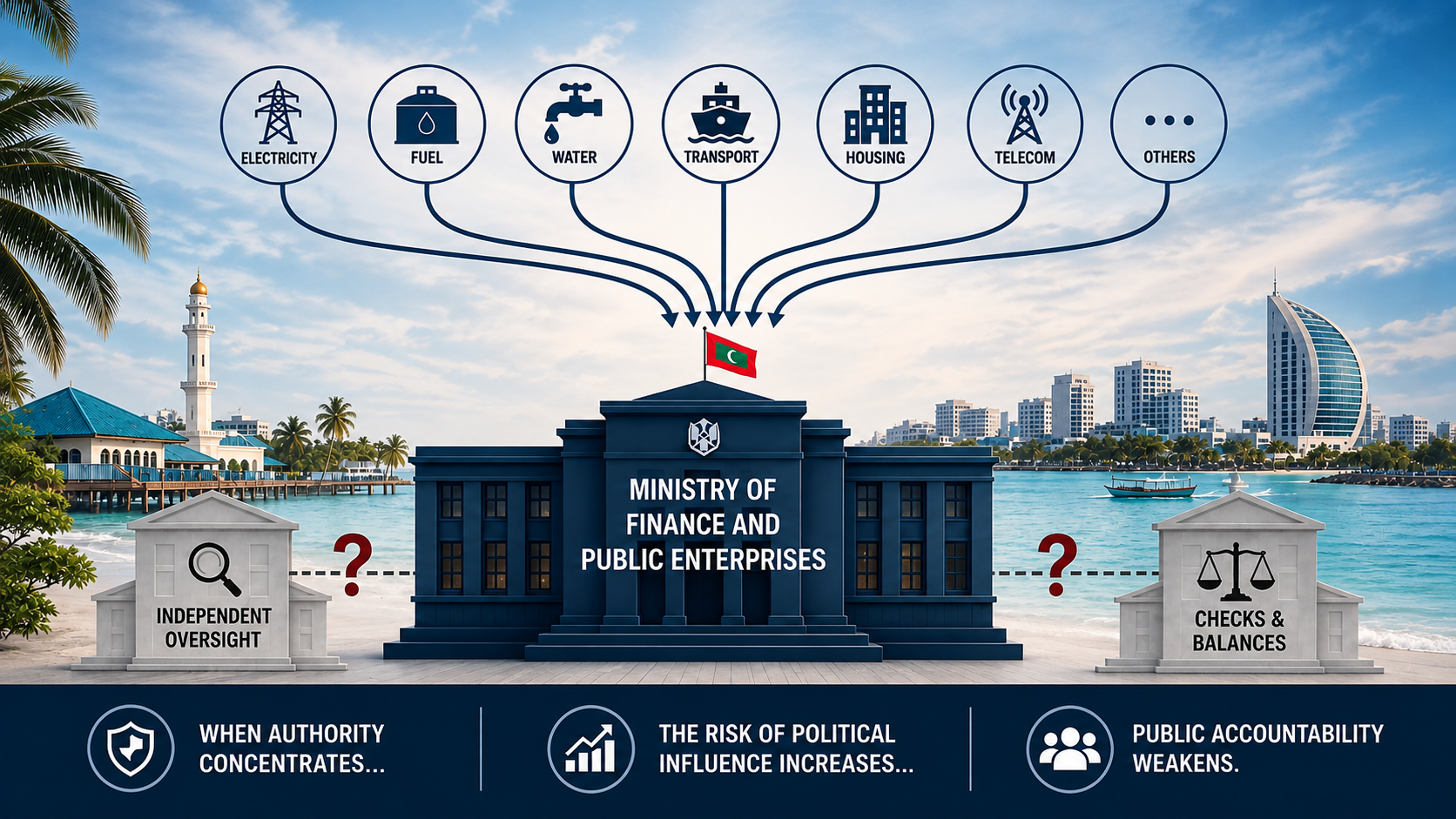
The recent decision to rename the Ministry of Finance and Planning as the Ministry of Finance and Public Enterprises represents more than administrative restructuring. Ministries are occasionally renamed to reflect expanding mandates or shifting priorities. Yet this particular change signals a deeper institutional shift. It concentrates responsibility for state-owned enterprises (SOEs) within the same ministry that controls national finances, subsidies, guarantees, and borrowing decisions.
This consolidation raises a troubling governance concern. When ownership authority, fiscal control, and oversight responsibilities converge within a single political structure, the institutional distance designed to protect enterprise independence narrows. Over time, this increases the risk that strategic decisions are influenced by short-term political priorities rather than long-term institutional discipline.
This shift did not begin with the renaming itself. Its direction was first signalled during the preparation of the 2025 national budget. Information Box 5 of the Budget 2025 proposed repealing the Privatisation and Corporatisation Act (Law no: 3/2013) and transferring responsibility for managing the affairs of SOEs to the Ministry of Finance, acting in its capacity as shareholder.
Centralisation without corresponding strengthening of oversight increases risk rather than reducing it.
Although the repeal was not implemented, the proposal revealed a clear preference for centralised control. More importantly, while the reform framework outlined several structural improvements, subsequent developments show limited evidence that these reform objectives were credibly implemented. This gap between reform commitment and institutional execution is significant.
Concentration of authority and political influence
The central concern arising from these recent institutional changes is not administrative efficiency alone. It is the growing concentration of authority over SOEs within a singular political structure.
SOEs manage public capital and provide essential services. Their governance frameworks were originally designed to protect commercial decision-making from undue political influence. When authority over fiscal policy, enterprise ownership, and supervisory functions become concentrated within one ministry, the safeguards designed to protect independence weaken.
Political influence rarely appears suddenly. It develops gradually, through structural alignment and concentration of authority. Decisions that should be guided by financial discipline and operational performance may increasingly reflect policy priorities or short-term administrative objectives.
This is not an abstract concern. It is a risk that grows quietly over time.
PCB was created to prevent this
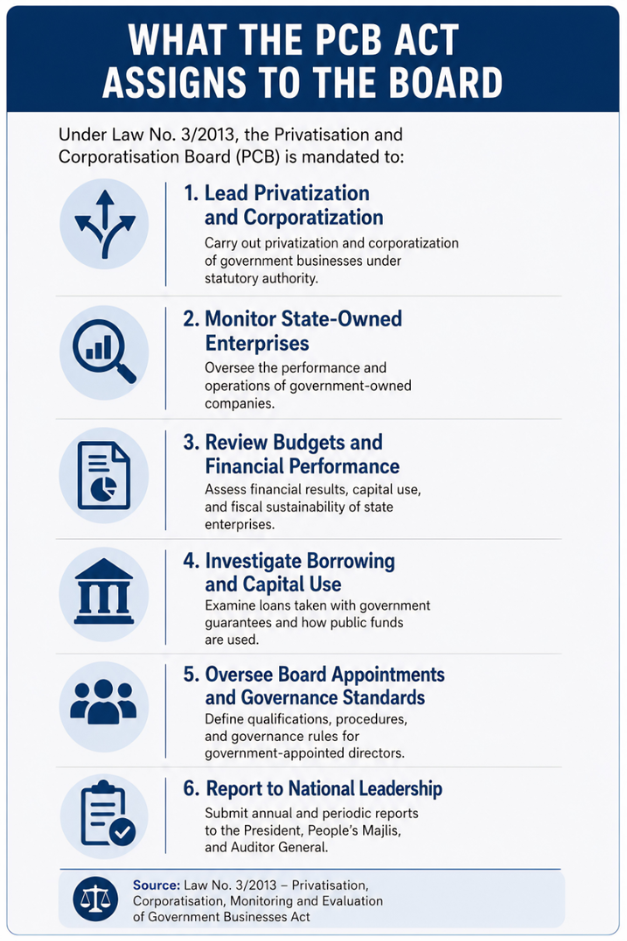
The Maldives established the Privatization and Corporatization Board in 2013 to introduce structured oversight into the governance of SOEs. The purpose of the Board was to create institutional distance between political authority and commercial management. It was expected to monitor performance, enforce governance standards, and provide transparency in the management of public assets.
Institutional safeguards depend not only on law but on implementation.
The logic behind this framework was clear. State-owned enterprises operate with public funds. Their decisions affect national finances and daily life. Independent oversight was intended to prevent discretionary decision-making and reduce the risk of politically driven financial commitments.
In theory, PCB represented a safeguard against concentration of power. It was designed to ensure that public enterprises operated under defined governance principles rather than direct political control.
However, institutional safeguards depend not only on law but on implementation.
Institutional capacity developed slowly
While PCB was established under statute in 2013, several institutional conditions required for effective independence developed only gradually over time.
An independent Secretary General, essential for operational leadership, was appointed only in late 2022. A Civil Service-approved organisational structure was established later, in January 2023. For several years after its establishment, administrative staffing authority and operational resources remained closely linked to the Ministry responsible for fiscal management.
These structural conditions did not remove PCB’s legal authority. However, they constrained its operational independence. Oversight existed formally in law, yet functioned within administrative frameworks that limited the Board’s ability to act with full institutional autonomy.
Operational experience over time also showed that governance functions, including monitoring and evaluation, depended heavily on institutional support that was not consistently provided. Key policies and governance tools were developed, yet the broader administrative environment required to sustain independent oversight evolved slowly.
This pattern created a system where institutional safeguards existed, but their effectiveness depended largely on administrative alignment rather than structural independence.
Reform promised, implementation limited
Budget 2025 outlined several reform intentions for the state-owned enterprise sector. These included strengthening governance mechanisms, improving financial discipline, and restructuring oversight responsibilities. The proposals were presented as part of a wider effort to modernise the management of public enterprises.
Modern governance principles emphasise the importance of separating ownership from oversight.
However, while reform intentions were clearly articulated, subsequent developments raise important questions about implementation. Several structural elements required to support meaningful reform did not advance at the pace implied by the reform framework.
Institutional strengthening requires more than policy announcements. It requires measurable changes in organisational capacity, governance enforcement, and transparency practices. Where authority expands faster than accountability mechanisms, the risk of failure increases.
This imbalance between reform commitment and execution creates a particularly sensitive institutional environment. It allows authority to concentrate while oversight remains structurally limited.
The ministry renaming formalises trajectory
Against this background, the renaming of the Ministry to include Public Enterprises formalises a direction that had already begun to emerge.
The addition of public enterprises into the Ministry’s identity signals an institutional shift toward centralised shareholder control. Fiscal authority, enterprise ownership, and supervisory influence now sit within the same administrative structure.
Modern governance principles emphasise the importance of separating ownership from oversight. Governments may act as shareholders, but independent institutions must retain the authority to evaluate performance and enforce accountability.
When these functions converge within one ministry, the risk of politicisation increases. Decisions affecting borrowing, subsidies, tariffs, and capital investment become more closely aligned with executive priorities. Independent scrutiny becomes harder to sustain.
This shift may not produce immediate institutional failure. Instead, it creates conditions under which governance discipline weakens gradually.
It is not whether PCB exists, but rather can it function independently
It is important to state clearly that PCB has not been dissolved. The statutory framework establishing the Board remains in force.
However, the practical question today is not whether PCB exists in law, but whether it retains sufficient independence in practice to perform its intended role.
Independence requires more than formal authority. It requires control over staffing, resources, reporting structures, and operational decision-making. Without these elements, oversight becomes procedural rather than corrective.
When governance becomes centralised and oversight weakens, financial risks accumulate quietly.
Institutional experience over the past decade demonstrates that independence in law does not automatically translate into independence in operation. Where administrative alignment limits operational autonomy, oversight risks losing effectiveness.
This distinction is central to understanding the current governance environment.
Why this matters for the public
The consequences of weak oversight does not remain confined to institutions. They affect citizens directly.
Many SOEs provide essential services such as electricity, fuel distribution, water supply, transport services, and housing infrastructure. Their borrowing affects national debt levels. Their operational decisions influence service quality. Their tariffs shape household expenses.
When governance becomes centralised and oversight weakens, financial risks accumulate quietly. Borrowing obligations expand. Subsidies increase. Fiscal exposure shifts into enterprise accounts.
These risks eventually become visible through rising tariffs, declining service reliability, or increased public debt burdens.
Weak oversight therefore carries real economic consequences.
A caution against further centralisation
The recent ministerial restructuring should be understood as a governance signal. It reflects a shift toward centralised control of SOEs at a time when institutional independence remains incomplete.
Centralisation may improve administrative coordination. However, without corresponding strengthening of independent oversight, it increases the risk of political influence over enterprise governance.
Reform design must preserve institutional balance.
Institutional experience over the past decade demonstrates that concentration of authority without strengthening accountability mechanisms weakens governance discipline. It reduces transparency and narrows the space for independent evaluation.
These outcomes are not inevitable. They depend on how institutional roles evolve from this point forward.
The real governance question
Reform of SOEs is necessary. Efficiency improvements, financial discipline, and service reliability are legitimate policy objectives.
But reform design must preserve institutional balance.
Ownership authority must not replace independent oversight. Administrative convenience must not weaken governance safeguards. Centralisation must not outpace accountability.
The renaming of the Ministry signals that authority is becoming more concentrated. Whether this leads to stronger governance or increased political influence will depend on how institutional independence is protected in practice.
That is the central caution raised by recent developments. Not whether SOEs will be restructured. But whether the systems designed to monitor them remain strong enough to protect the public interest.