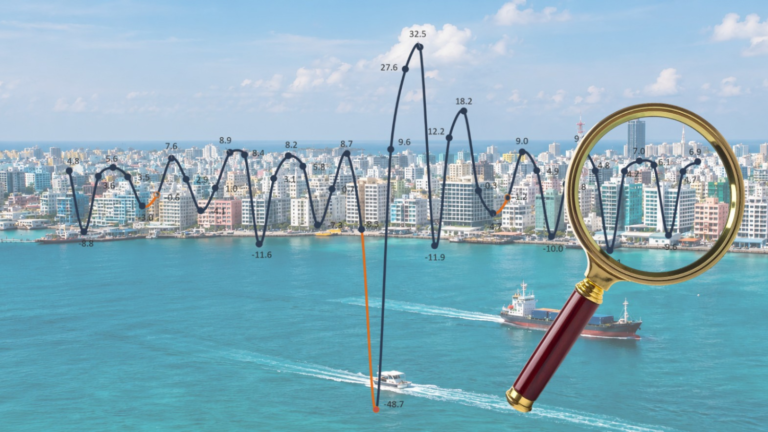
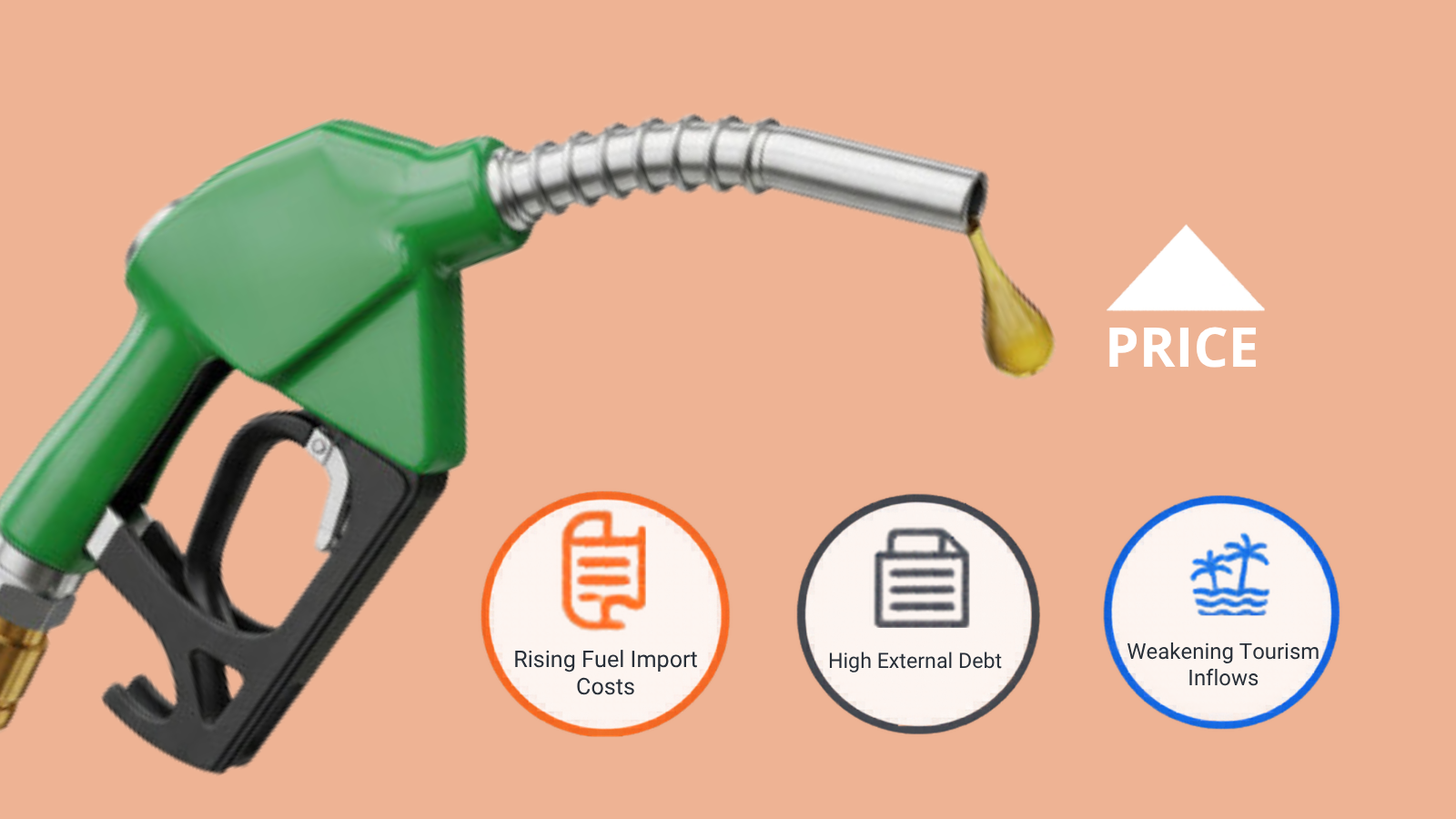
The Maldives needs smarter policies to address the squeeze being felt nationwide, from businesses to household budgets, as sharp fuel price hikes linked to the Gulf crisis feed through the economy.
On 5 March, Maldivians woke up to the largest fuel price increase in recent years. Petrol at Fuel Supply Maldives (FSM) pumps rose from MVR 13.50 to MVR 16.01 per litre, while diesel increased from MVR 13.92 to MVR 17.54, a jump of roughly 18 to 26 percent in a single step. In an economy almost entirely dependent on imported fuel, from ferries and fishing boats to powering schools and households on the islands, this is not just a headline. It is a direct increase in the cost of living nationwide.
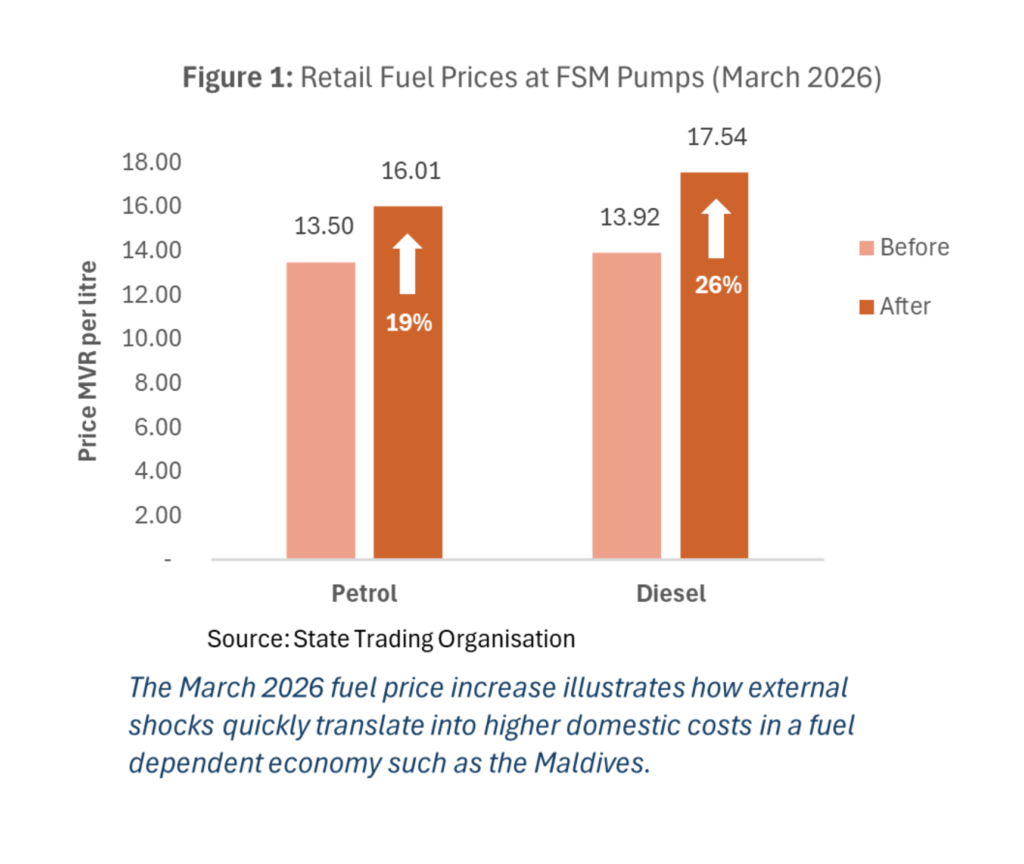
What begins as a global shock soon becomes a local burden for households across the Maldives.
Fuel sits at the centre of the Maldivian cost structure. As prices rise, the impact is immediately felt in electricity, transport, and the movement of goods, pushing up the price of food and basic necessities across every atoll. What begins as a global shock soon becomes a local burden for households across the Maldives.
This shock did not originate in the Maldives. It reflects rising tensions in the Middle East that are disrupting not only energy markets but also trade routes. Oil prices have increased and remain volatile, while uncertainty around key shipping corridors has raised freight and insurance costs. For a country that depends heavily on imported fuel and stable international connectivity, these developments have immediate consequences.
On paper, the economy appears resilient. GDP grew by about 5.4 percent in 2025, supported by a strong tourism year with receipts exceeding USD 5 billion. Yet the underlying ground reality is more fragile. Public and publicly guaranteed debt is roughly 133 percent of GDP at the end of 2025 with more than USD 1 billion in external repayments falling due in 2026. The space to absorb repeated shocks is paper thin.
These developments show how quickly global disruptions translate into domestic pressure in a small, import-dependent economy. The current crisis is a reminder that everyday economic stability in the Maldives is closely tied to events far beyond its borders.
The Gulf Crisis and Energy Markets
The current risks centre on the Strait of Hormuz, a key route for global oil and gas flows. Even the partial disruption now being faced globally has pushed prices and shipping costs up. Airlines have rerouted flights to avoid conflict zones which has led to increases in travel times and operating costs.
Larger economies with more diversified suppliers, bigger fuel reserves and less dependence on imported fuel have more tools to cushion such shocks. For the Maldives, where storage is limited and as it sits at the end of long supply chains, the effects are sharper and arrive sooner.

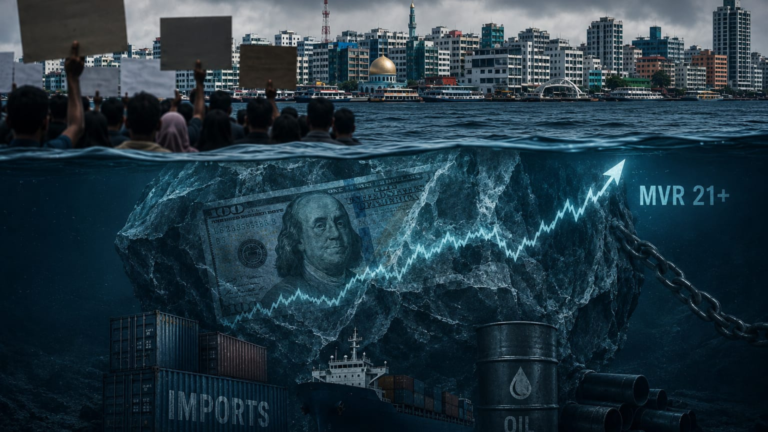
In 2025, petroleum products accounted for nearly one fifth of total imports, around USD 710 million out of USD 3.6 billion. Supply is also highly concentrated. About 80 percent of fuel imports came from Oman and the United Arab Emirates (UAE). This means changes in Gulf energy markets pass quickly into domestic costs.
The exposure extends beyond fuel. Gulf Cooperation Council (GCC) countries supplied around 27 percent total goods imports, including food products, industrial inputs and consumer goods. Disruptions in the Gulf therefore affect not only fuel prices but also the availability and cost of a wide range of essential goods.
Economic Ripple Effects
Tourism Under Pressure
Tourism is the Maldives’ main source of foreign exchange, and early signs point to strain.
Tourist arrivals between 1 and 16 March 2026 were close to 21 percent lower than the same period in 2025. Cancellations across resorts and guesthouses are now affecting occupancy and cash flow. Connectivity is also weakening, with around 20 flight cancellations per day reported.
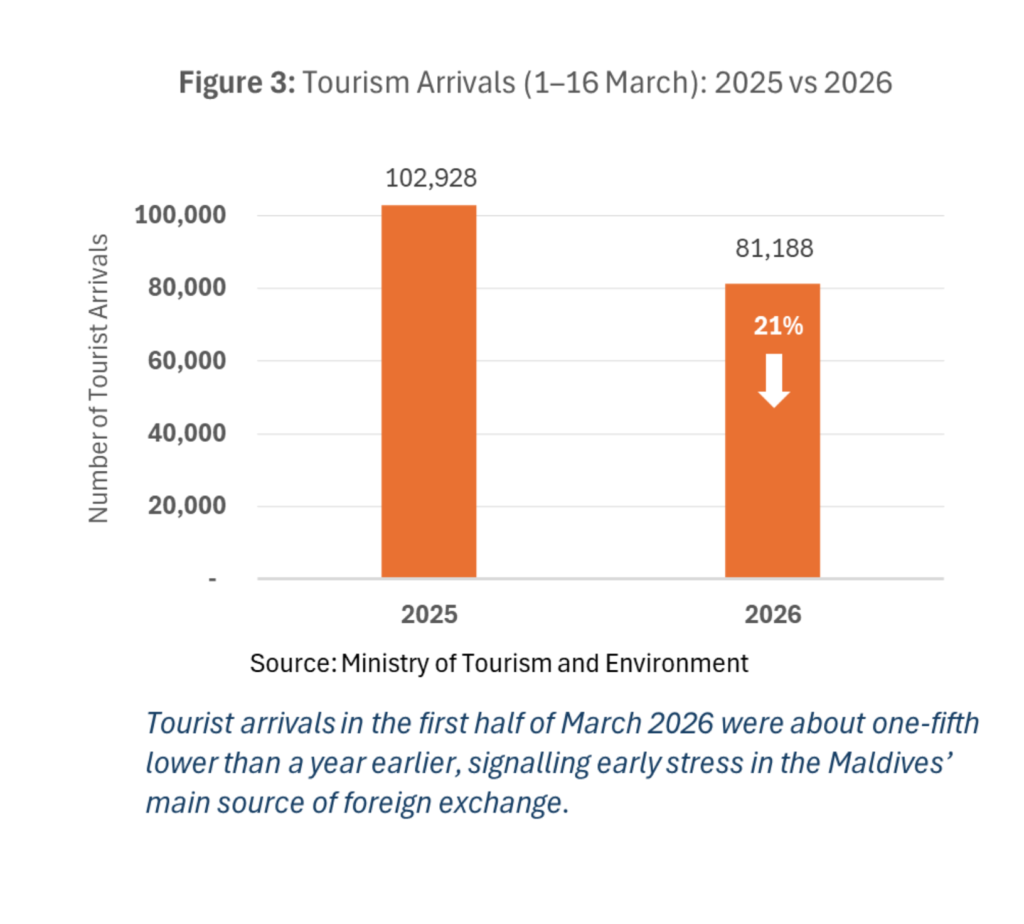
For a country that depends on uninterrupted access by air, even short disruptions reduce visitor inflows. Since tourism earnings finance imports and a large share of government revenue, a sustained slowdown would quickly affect foreign currency availability and fiscal stability.
Tourism is the Maldives’ main source of foreign exchange, and early signs point to strain. Tourist arrivals between 1 and 16 March 2026 were close to 21 percent lower than the same period in 2025. Cancellations across resorts and guesthouses are now affecting occupancy and cash flow.
Connectivity is also weakening, with around 20 flight cancellations per day reported. For a country that depends on uninterrupted access by air, even short disruptions reduce visitor inflows. Since tourism earnings finance imports and a large share of government revenue, a sustained slowdown would quickly affect foreign currency availability and fiscal stability.
Recent changes in jet fuel prices are adding further strain. Maldives Airports Company Limited (MACL) has raised the jet fuel selling price at Velana International Airport and other MACL‑managed airports from USD 1.19 to USD 1.69 per litre, a 50‑cent, or 42 percent, increase described as the highest rate in recent years. Airlines are already responding with higher fares and fuel surcharges, which risks making the Maldives a more expensive destination while demand is also softening.
The broader security backdrop is also darkening. Recent reports that Iran has threatened “parks, recreational areas and tourist destinations” worldwide have added to concerns that the war could spill over into attacks on tourism itself, which would further weigh on travel confidence and air connectivity.
Fuel Prices and Transport Pressures
The most immediate impact is through fuel prices. The increase at FSM pumps was followed by sharp adjustments in bulk supply rates to private distributors. In the Malé region, diesel prices for businesses rose significantly within days, while in the atolls retail prices have spiked.
Transport costs have responded quickly. Ferry fares on major routes have increased sharply, with some routes seeing significant increases. For households and small businesses, this raises the cost of travel, trade, and daily activity. In outer islands, where supply chains are longer, the impact is even more pronounced.
Authorities have announced plans to use State Trading Organisation (STO) profits and subsidies to stabilise prices. While this may ease immediate pressure, it shifts the burden onto public finances if high prices persist.
Macroeconomic Pressures
The combined effect of weaker tourism and higher fuel costs is now visible in the nation’s external position. Rising oil prices are estimated to add around USD 1 million per day to the import bill, and the International Monetary Fund’s rule of thumb is that every sustained 10 percent increase in energy prices raises global inflation by around 0.4 percentage points and shaves 0.1 to 0.2 percentage points off growth.
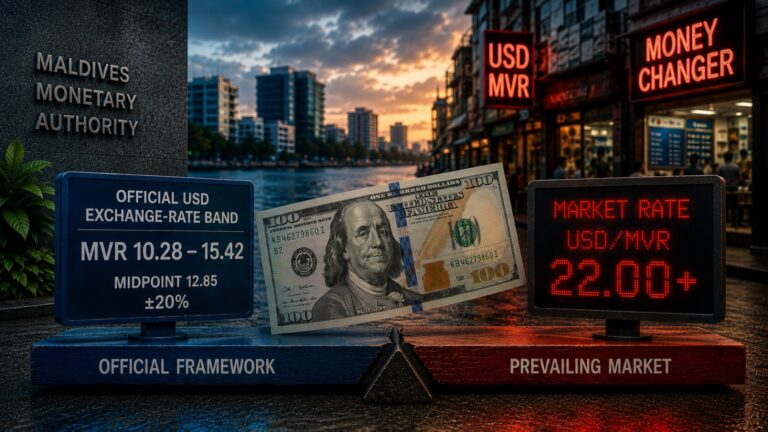
With limited reserves and a persistent current account deficit, essential payments for fuel, food, and debt service are beginning to compete for scarce foreign currency. Higher import costs are likely to pass through to domestic prices, adding to inflation and reducing real incomes.
Financial sector risks also loom large. Banks have exposure to sectors such as tourism and real estate, and a large share of their balance sheets is linked to foreign currency. Stress in the external position could translate into tighter liquidity and higher financial risks.
With the IMF warning that a prolonged energy price shock could re‑ignite inflation and weaken growth worldwide, countries with high debt and thin reserves have even less room for hesitation.
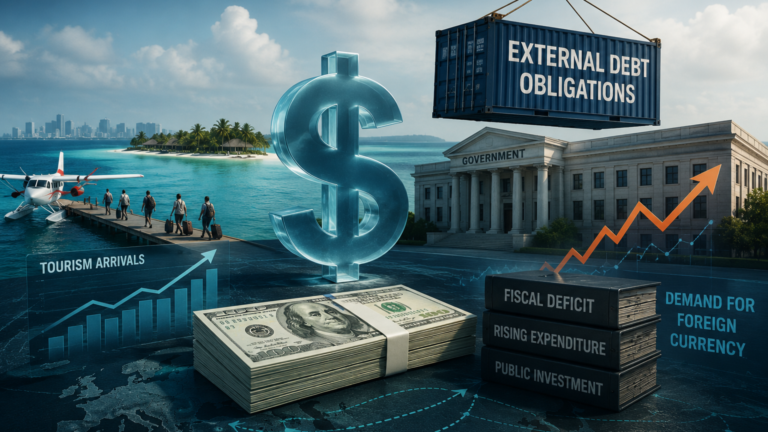
Public finances are already under strain. Subsidies and support measures provide short term relief but add to a budget that faces high debt service costs and relies on domestic borrowing. With total public and publicly guaranteed debt now around MVR 155 billion, roughly 133 percent of GDP at end‑2025, and significant external repayments due in 2026, the margin for absorbing further shocks is narrow.
External vulnerabilities are not just about who we buy fuel and food from, but also who we owe money to. While GCC and Arab funds such as the Saudi Fund for Development, Abu Dhabi Fund and Kuwait Fund are important lenders, they account for only around one‑fifth to one‑quarter of total external public and publicly guaranteed debt. India’s Exim Bank, Chinese lenders and international bond investors together remain larger exposures. In practice, this means the Maldives is financially tied into several regions at once, even as its import and tourism links leave it heavily exposed to the Gulf.
Threats to Food Security
Food security in the Maldives is closely linked to imports. A large share of food is sourced abroad and distributed across widely dispersed islands. This makes the system sensitive to global prices, shipping conditions, and domestic transport costs.
A growing share of food imports comes from GCC countries, including poultry, meat, and processed foods. Disruptions in the Gulf can therefore affect both availability and price.
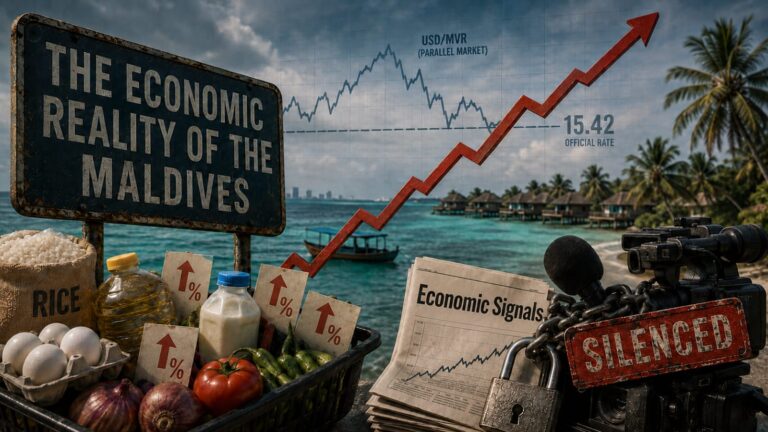
Higher fuel costs increase the cost of shipping and distribution, while rising freight and insurance costs add further pressure. Early reports indicate that food prices are already increasing, particularly in outer atolls. Lower income households, which spend a larger share of income on food and transport, are most affected.
If disruptions persist, the issue may extend beyond price increases to supply reliability. While current systems continue to function, prolonged instability could expose the limits of existing storage and distribution capacity.
What Maldives Should Be Doing Now
The situation calls for clear and timely action. The pressures now emerging are early warning signals, and how they are managed will determine whether they remain contained or develop into broader instability. With the IMF warning that a prolonged energy price shock could re‑ignite inflation and weaken growth worldwide, countries with high debt and thin reserves have even less room for hesitation. But so far, the response has been muted and fragmented.
Many countries facing similar risks have already begun acting. Measures such as building fuel reserves, securing alternative supply routes, and using targeted subsidies and price caps to cushion households are being deployed across Asia and beyond. The Maldives is not being asked to do anything unusual, but to apply the same kind of timely and coordinated response.
Immediate priorities are clear. Households and small businesses need protection through targeted support focused on food, transport, and electricity. Foreign exchange must be prioritised for essential imports such as fuel, food, and medicines, with clearer communication on external debt management to maintain confidence. Supply resilience should be strengthened by securing stable import arrangements and improving coordination, and efficiency across the supply chain.
The experience of 2020 and 2021 offers useful lessons. During the pandemic, selective spending cuts and targeted support helped protect jobs and businesses. However, that response relied heavily on borrowing and monetary support, which is not sustainable today.
To avoid repeating the same approach, structural changes are needed.
A permanent, means-tested income support system should replace ad hoc emergency schemes, allowing faster and more predictable assistance during downturns. An unemployment insurance scheme should be established to support displaced workers without placing the full burden on the budget.
Foreign exchange management should be formalised through a clear priority framework that ensures essential imports are protected during periods of stress. The transition to renewable energy should be accelerated, not only as an environmental goal but as a way to reduce reliance on imported fuel.
Finally, a Sovereign Resilience Fund should be established. A modest fund, built up during strong years and protected from routine spending through clear and robust legislative safeguards, would provide a domestic buffer during future shocks and reduce reliance on emergency borrowing.
A Narrow Window to Build Resilience
The pressures now facing the Maldivian economy are part of a broader chain reaction that begins with global conflict and ends in household budgets. Higher fuel prices, weaker tourism inflows, and rising food costs are already a reality. If these persist, they will test the country’s external position and fiscal stability.
These vulnerabilities are not new, but they have become more visible. In a small, open economy, resilience must be built before crises occur; not in the midst of one.
Resilience must be built before crises occur; not in the midst of one.
What is required now is a shift in approach. Clear communication, targeted support, disciplined use of foreign exchange, and stronger coordination across institutions are essential in the short term. Over time, these must be reinforced by lasting reforms that reduce dependence on external shocks.
The Maldives cannot rely indefinitely on favourable global conditions to sustain stability. Strengthening fiscal discipline, reducing reliance on imported fuel, and building a more diversified economic base are no longer long-term goals. They are immediate priorities.