The US dollar occupies a unique position in the Maldivian foreign-exchange market.
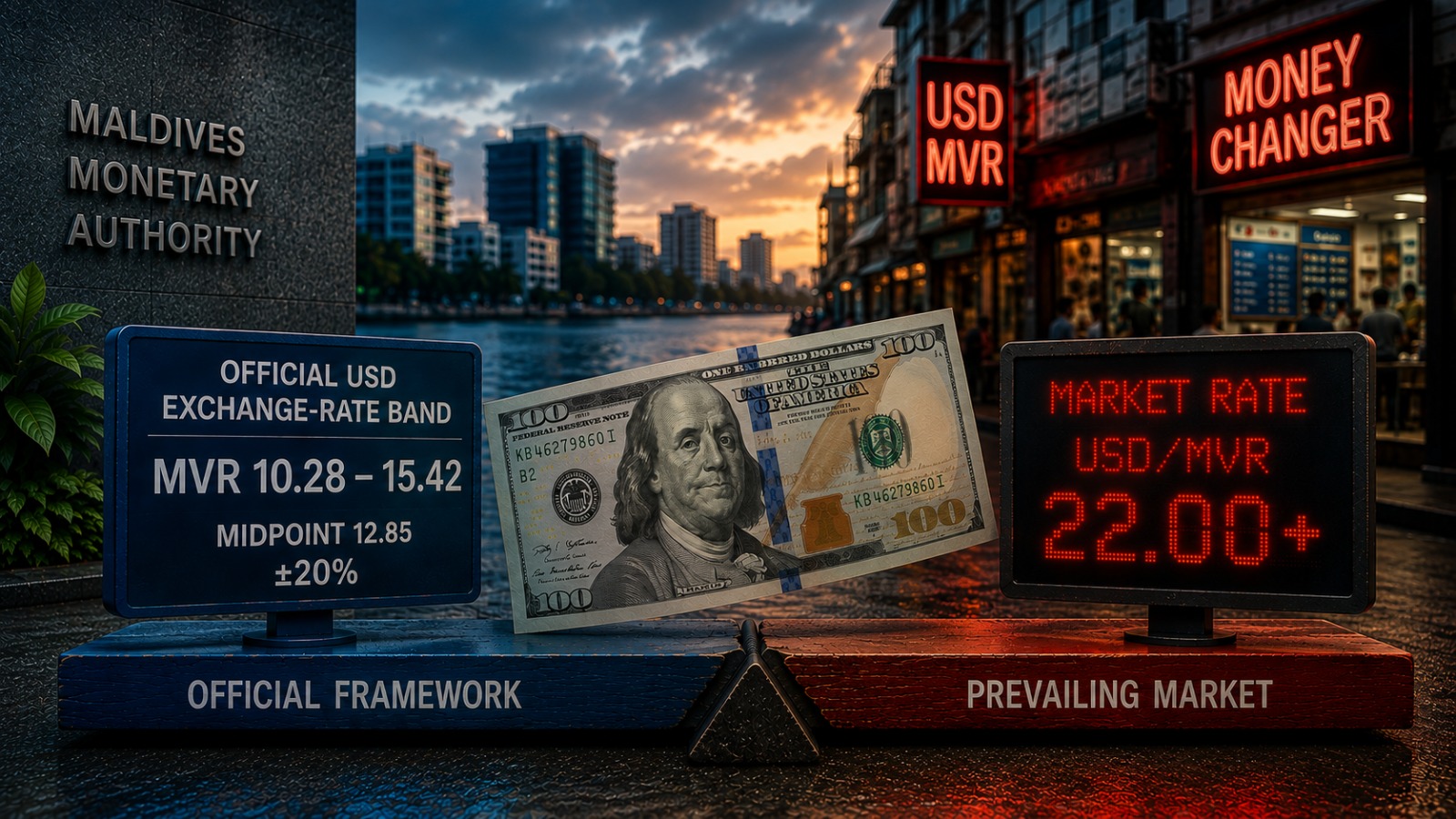
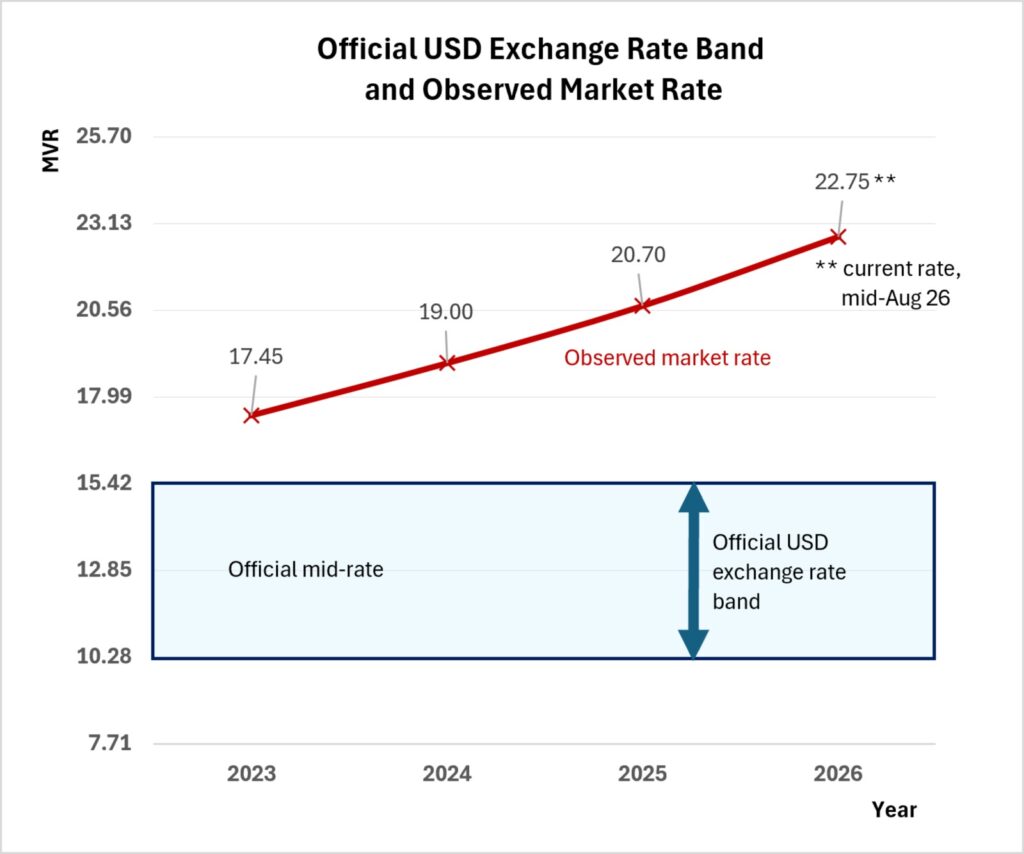
Unlike other foreign currencies, the exchange rate between the US dollar (USD) and the Maldivian Rufiyaa (MVR) is determined by the Maldives Monetary Authority (MMA). The official framework sets a midpoint of MVR 12.85 per US dollar, with a permitted fluctuation band of ±20 percent, placing the upper end at MVR 15.42.
Yet dollars are also bought and sold at substantially higher rates. More importantly, from a regulatory perspective, such transactions are not necessarily confined to an unregulated informal market. MMA itself licenses businesses to engage in money-changing activities.
This raises a deceptively simple question: at what rate can an MMA-licensed money changer legally buy or sell a US dollar?
As the gap between the official rate and the prevailing market rate widens, the answer becomes significantly critical. Rather than debating whether the dollar is bought and sold at MVR 20, MVR 22 or any other rate, the more fundamental question for the integrity of the financial system is what does the regulatory framework permit?
What Does the MMA Act Say?
Section 23 of the Maldives Monetary Authority Act (6/81) gives MMA broad authority over foreign-exchange dealings. Under Section 23(2), MMA may determine and publish the rates at which foreign currencies may be bought, sold or otherwise dealt in by banks and other permitted parties. Section 23(3) allows MMA to determine a mid-rate around which buying and selling rates may be established.
Section 24 deals with the exchange-rate regime. It gives MMA responsibility for determining and implementing the policies necessary to give effect to that regime. Importantly, Section 24(b) prohibits the purchase or sale of a foreign currency at a rate other than that determined pursuant to the exchange-rate regime, where such a determination has been made for that currency. Section 24(c) provides substantial penalties for contraventions.
The legislation therefore gives MMA authority not merely to publish rates, but to determine the rates governing foreign-exchange transactions and to ensure that the exchange-rate regime is implemented accordingly.
However, the question is how MMA exercises that authority to uphold the USD exchange-rate regime and enforce the rules governing licensed money changers.
The Dollar Is Different
Licensed money changers play an obvious role in the economy. Travellers and businesses require currencies such as the euro, pound sterling, Indian rupee and Singapore dollar, for which exchange rates against the Maldivian Rufiyaa have not been prescribed by MMA.
For these currencies, licensed money changers may determine their own buying and selling rates based on prevailing market conditions, with a commercial spread. These rates must be prominently displayed at their licensed business premises.
At what rate can an MMA-licensed money changer legally buy or sell a US dollar?
However, the US dollar must be treated differently. Its exchange rate against the Rufiyaa is prescribed within the official exchange-rate framework.
Clause 37 of the Regulation on Money Changing Business (2024/R-92) makes this distinction particularly important. Clauses 37(a) and (b) require licensed money changers to display their buying and selling rates. But Clause 37(c) provides that where MMA, pursuant to Section 24(b) of the MMA Act, determines the buying and selling rates for a particular foreign currency, that currency cannot be bought or sold at another rate. Additional commissions or fees also cannot be charged without MMA’s prior approval.
Clause 37(d) provides for penalties under Section 24(c), ranging from MVR 10,000 to MVR 1 million, or up to five times the value of the transaction involved.
What Does the Official USD Band Mean?
Taken together, these provisions raise an unavoidable regulatory question:
Does the official US dollar exchange-rate band of MVR 10.28 to MVR 15.42 constitute the “determination of buying and selling rates for a specific foreign currency” referred to in Clause 37(c) of the Regulation on Money Changing Business, pursuant to Section 24(b) of the MMA Act?
If YES; can an MMA-licensed money changer legally buy or sell US dollars outside that band?
If NO; what precisely is the legal and regulatory significance of the published band, and what purpose does it serve?
The legislation and regulations do not by themselves make sufficiently clear how MMA applies Clause 37(c) to USD transactions by licensed money changers in practice. Clarification from MMA would therefore be useful.
A Question of Regulatory Credibility
A fixed exchange-rate regime does not necessarily require every retail transaction to occur at exactly the same price. Banks and dealers normally operate with buying and selling spreads. But there is a fundamental difference between a commercial spread around an official rate and a market price more than 40 percent above the upper limit of the official band.
This takes the issue beyond exchange-rate economics to regulatory certainty and the rule of law.
If transactions outside the official USD band are lawful, the basis should be clear. If not, it becomes a question of enforcement.
MMA determines and implements exchange-rate policy while also licensing and supervising money-changing businesses. Businesses should know what the law permits. Consumers should know whether the market in which they transact is lawful. Regulators should apply the rules consistently. And where the law establishes prohibitions and penalties, the relevant authorities have a responsibility to ensure they are observed.
If transactions outside the official USD band are lawful, the regulatory basis should be clear. If they are not lawful, the question becomes one of enforcement.
With the official rate at MVR 15.42 and the prevailing market rate recently reported above MVR 22, this is no longer a marginal difference that can readily be understood as a dealer’s spread. More importantly, the prevailing market rate sits substantially outside the official exchange-rate band.
The issue therefore goes beyond the price of the dollar. It concerns the credibility of the regulatory framework and, ultimately, the rule of law.
If the law establishes the rules governing the foreign-exchange market, who is responsible for ensuring those rules are followed?