
What years of working with students reveal about this moment.
The exams are done. For many families across the Maldives right now, there is a quiet exhale — the late nights, the revision, the anxiety, all of it temporarily set aside. But in that pause, before the results arrive and before the next enrolment begins, there is a window that often closes before anyone realises it was open. The window where a young person’s direction is still genuinely shapeable.
This is the moment I want to talk about.
Where Is Your Child Headed?
In my years working with students at exactly this crossroads, as an educator, as a researcher, as someone who has sat across from young people carrying the weight of everyone’s expectations, what I observed most often was not a lack of ambition. It was a lack of information. Students choosing A Level streams based on what sounds respectable, what a relative studied; what the family imagines a good future looks like. Then discovering, two or three years later, that their subject combination had quietly closed doors they had not known they wanted open.
The problem is not a lack of ambition. It is a lack of information.
Because that is how the chain works. A Level subject choices shape degree eligibility. Degree eligibility shapes career pathways. And career pathways, in a country as small and specific in its needs as the Maldives, have consequences that extend well beyond the individual family making the decision.
That pattern deserves an honest conversation. This is my attempt at one.
What the Country Actually Needs
The Ministry of Education, Higher Education and Skills Development conducts a Training Needs Analysis published in 2021 as Government Training Requirements 2021–2023, that maps qualification gaps across the public sector. The findings are significant. Over 12,000 training requirements were identified, with the Ministry of Education alone accounting for more than 4,400 and the Ministry of Health over 4,200. The priority areas are consistent and specific: subject-specialised teachers, nurses and healthcare workers, ICT professionals, and people trained in agriculture and technical trades. These are not aspirational categories. They are documented shortfalls in roles the country needs to function.
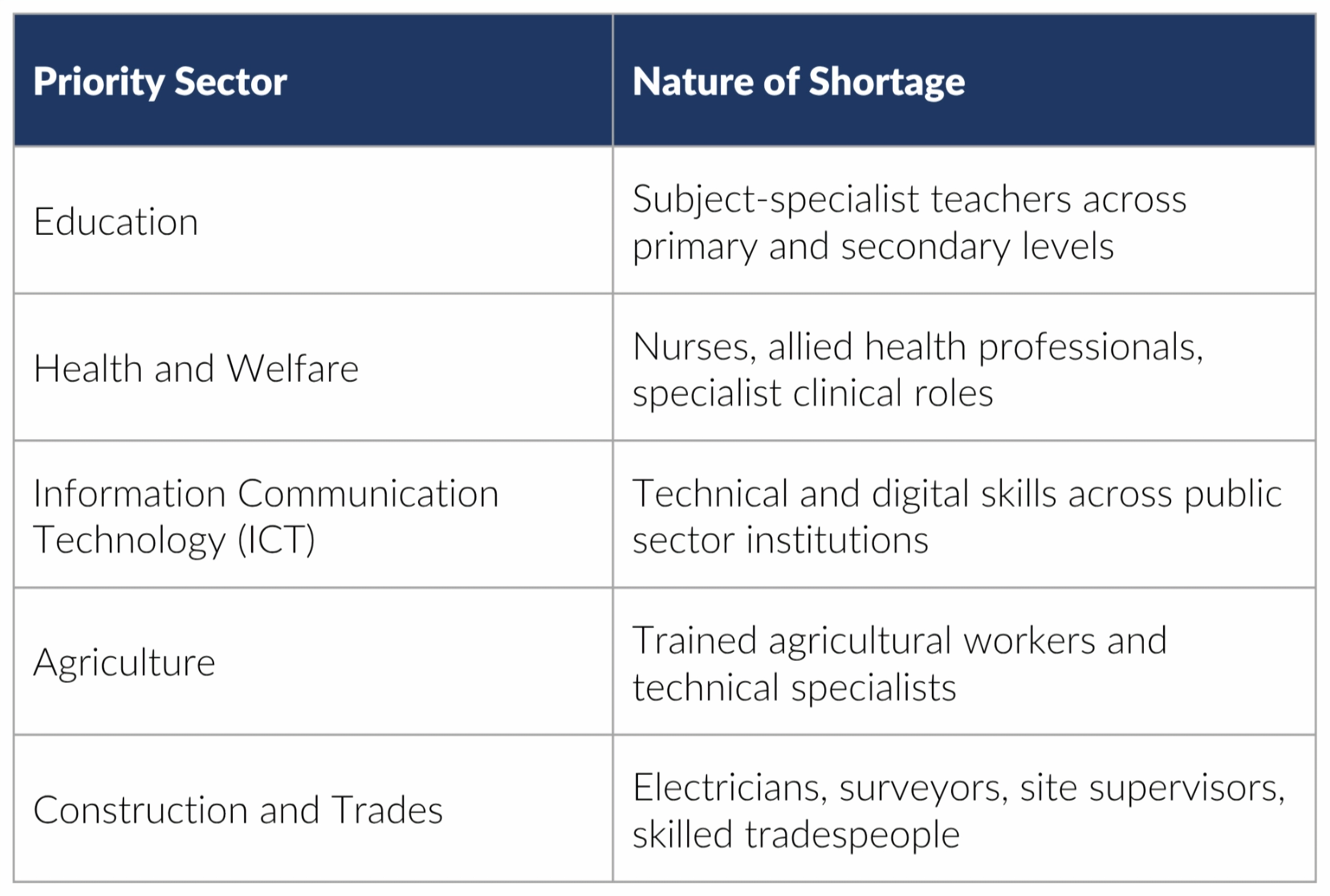
The President’s Scholarship and the Free Degree Scheme increasingly reflect these national priorities. Public funding for higher education is not distributed equally across all fields. It is directed towards areas where the country’s skills shortages are greatest. Students who choose subjects that lead to careers in nursing, ICT, teaching, agriculture or technical trades are therefore positioning themselves not only for opportunities that align with national needs, but also for programmes that receive greater public support. Most families do not know this. And so, the A Level conversation happens without it, based on instinct, social pressure, and what sounds impressive at the dinner table.
The Industry We Do Not Talk About
Ask a Maldivian parent what they want for their child and you will hear familiar answers. Doctor. Lawyer. Engineer. Government officer. What you will almost never hear? Carpenter. Electrician. Construction Supervisor. Surveyor.
And yet these are among the roles the country needs most urgently, and fills them largely with people from abroad.
Many of the skilled hands and minds building our homes, resorts and infrastructure will eventually go home, taking their knowledge with them.
The numbers are difficult to look away from. The Maldives construction industry has an estimated 13 foreign workers for every local employee. Construction is the largest employer of expatriate workers in the entire country, accounting for 43 percent of the total expatriate workforce. The resorts being expanded, the housing going up in Hulhulmalé, the infrastructure spreading across atolls, the skilled hands and minds doing that work overwhelmingly belong to people who will eventually go home, taking their knowledge with them.
For many parents, these preferences come from understandable aspirations. They want stable, respected professions for their children. But labour markets evolve. Occupations once seen as secondary increasingly offer strong incomes, stable demand and opportunities for entrepreneurship. The challenge is not to lower aspirations but to broaden the definition of success.
Every skilled expatriate employed in these occupations represents income that leaves the Maldivian economy. Meanwhile, employers continue to report shortages of suitably trained local workers while many young Maldivians struggle to find employment. This mismatch carries economic costs beyond individual career choices. It reduces opportunities for local households, limits the development of domestic skills, and increases the country’s reliance on imported labour.
This is not an abstract policy problem. It is a direct economic loss. Wages that could belong to Maldivian families are leaving the country. Expertise that could be building local capacity is not being built here at all. And the reason, in large part, is cultural. Skilled trades are seen as a lesser choice, the path for those who did not make it academically. That perception is not just inaccurate. It is quietly costly.
Research across developing countries finds this pattern consistently. Parents associate vocational and technical education with low achievers and limited futures, steering capable students away from fields where they are genuinely needed and where many would genuinely thrive. A study from the Caribbean found that parental attitudes, not student disinterest, were the primary barrier to Technical and Vocational Education and Training (TVET) enrolment. The stigma, not the work, is the obstacle.
The global picture is shifting. The share of young people considering vocational or trade school has more than doubled internationally over the past six years, as the economic reality of skilled work becomes harder to ignore. In the Maldives, the 2025 regulation on expatriate employment has begun formally reserving roles including electricians, building inspectors, surveyors, and site supervisors for Maldivians on a structured timeline. The space is being created. The question is whether there will be enough people ready to step into it.
A Maldivian carpenter who understands local materials, island conditions, and how things are actually built here is not a fallback option. They are something the country has been paying to import for a very long time.
The Mismatch We Keep Producing
Youth unemployment in the Maldives stood at over 16 percent in 2024, while the country simultaneously employs over 177,000 expatriate workers (Maldives Bureau of Statistics, 2021) to fill roles that locals are not trained for. Both things are happening at once, and they are connected.
A peer-reviewed study by Shafeeq and Shareef, published in the Journal of Technical Education and Training (2023), found that rising educational attainment among young people has collided directly with the growth of demand in sectors such as tourism, construction and other technical occupations, producing a mismatch not because young people lack qualifications, but because many of the qualifications being pursued do not align with where the work actually is.
The World Bank’s 2024 Human Capital Review adds another important dimension. While a Maldivian child can expect 12.4 years of schooling, the equivalent of only 8.17 years of actual learning is achieved, suggesting that improving education quality remains a major challenge. Subject choices made without a clear sense of direction, together with persistent attitudes that undervalue vocational and technical careers, further reinforce the mismatch between education and labour market needs.
Weak learning outcomes, uninformed subject choices and persistent attitudes towards vocational careers are not separate problems. They are different expressions of the same labour market mismatch, and they require a response that begins at home.
How Parents Can Actually Help
None of this means passion does not matter. It does. Research is consistent on this. Young people who choose paths out of genuine interest, with a real sense of purpose, perform better, persist longer, and report higher wellbeing than those guided primarily by family expectation or social pressure. A child who genuinely wants to teach, and understands why that matters, will be a better teacher than one who studied it because it was funded and convenient.
What the research also shows is that parental involvement, when it tips from support into pressure, carries real costs. It is associated with school anxiety, reduced confidence in decision-making, and in more serious cases, burnout. There is a meaningful difference between helping a child see their options clearly and narrowing those options for them.
The most useful thing a parent can do right now is not arrive with the answer. It is to bring better questions. Not just what do you want to be, but what kind of life do you want, and what does the real path to that look like, here, in this country, right now. Not just what are you good at, but where does what you are good at meet what is genuinely needed.
And perhaps to be willing to reconsider what success looks like. A skilled Maldivian electrician working on resort infrastructure, earning a professional wage in a field the country cannot staff locally, is succeeding. A trained nurse doing work that no one else in their community is qualified to do is succeeding. A carpenter whose craftsmanship stays on these islands is contributing something lasting. The pathway does not determine the value of the work. The fit between the person, the path, and the place they belong to is worth more than the title.
What I Would Say to Every Parent Reading This
The exams are finished, but the real decision has not been made yet. That is the part worth paying attention to.
Success is not defined by a particular profession or title. It comes from finding the right fit between a person’s abilities, aspirations and the contribution they can make.
Encourage your child to explore their interests, understand where their strengths lie, and learn how those strengths connect with the opportunities and needs of the country. Success is not defined by a particular profession or title. It comes from finding the right fit between a person’s abilities, aspirations and the contribution they can make.
The choices made today will shape not only your child’s future, but also the future skills and capabilities of the Maldives. Taking the time to make an informed decision is one of the most valuable investments a family can make.
There is a list. It reflects where the gaps are, where the funding goes, and where the work is genuinely waiting.
Twelve thousand gaps, documented and named.
Your child is probably the answer to one of them.