
The Rufiyaa Question

Should the Maldives float its currency?

As the gap between the official and parallel exchange rates widens, the Maldives faces an increasingly urgent policy question; how should the exchange rate system evolve from its current constrained band toward a more sustainable framework? Experience elsewhere suggests that without stronger reserves, robust fiscal discipline, and deeper foreign exchange liquidity, a sudden move to float the currency could create more instability than stability.
The gap between the official exchange rate and the parallel market rate for the US dollar has become a serious national concern in the Maldives. Under the exchange rate framework introduced in 2011, the Rufiyaa is permitted to trade within a band of MVR 10.28 to 15.42 per US dollar. In practice, however, the official rate has remained at the upper limit of 15.42 for many years, while in the parallel market the dollar now trades above MVR 20.
This divergence signals growing pressure in the foreign exchange system. The question is no longer whether pressure exists, but how policymakers should respond.
For some observers, the answer appears straightforward: move to a floating exchange rate and allow the currency to adjust more freely to market conditions. But exchange rate reform is rarely that simple. It depends on credibility, foreign exchange reserves, the central bank’s capacity to intervene, and the sequencing of policy reforms.
Most importantly, it depends on foreign exchange liquidity. Exchange-rate systems do not function on price alone. They depend on whether foreign currency is actually available through the formal banking system.
Exchange rate debates often focus on price, but price alone does not determine stability.
How the System Evolved
The Rufiyaa has undergone several adjustments over the decades. After changes in the late 1980s, the exchange rate stood at about MVR 11.77 per US dollar in 1994. By 2001, it was revised to MVR 12.85 to reflect evolving economic conditions.
In April 2011, the Maldives Monetary Authority introduced a +/-20 percent fluctuation band around that rate, allowing the Rufiyaa to move between MVR 10.28 and 15.42. The intention was to introduce a form of managed flexibility while preserving stability.
In practice, however, the rate quickly moved to the upper limit and remained there. The ceiling of 15.42 gradually became the effective anchor of the system. While the official rate appeared stable, the availability of foreign exchange through the banking system became increasingly constrained. In any band-based exchange rate system, the credibility of the arrangement ultimately depends on the central bank’s ability to supply foreign currency and intervene when needed.
The Rufiyaa has not always operated under such pressure. In the late 1990s and early 2000s, foreign exchange was widely available through banks. Businesses could settle supplier invoices without prolonged delays, and households could convert funds with relative ease.
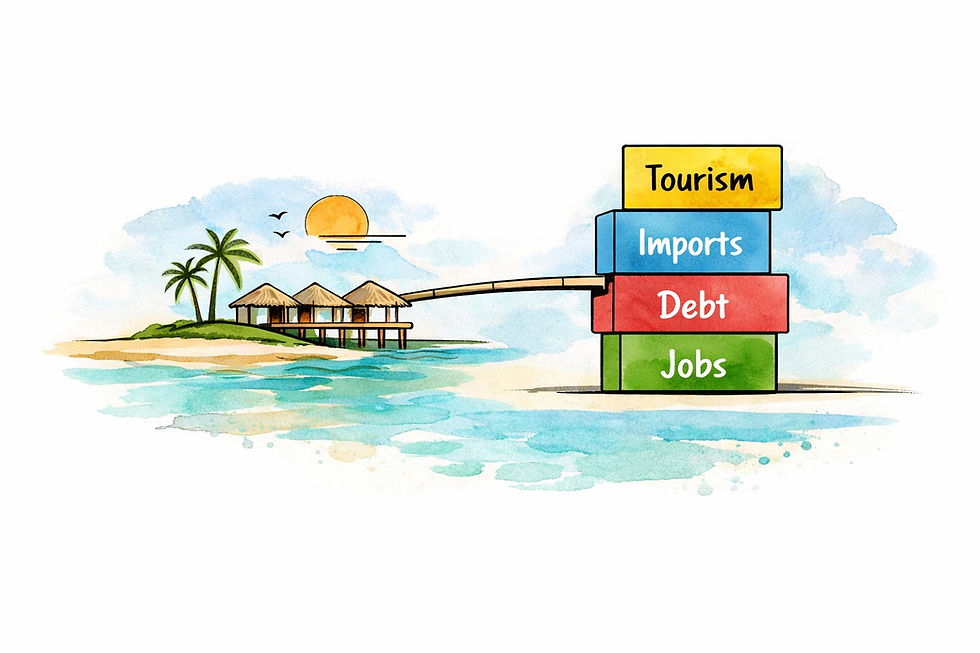
Over time, structural pressures intensified. Imports expanded alongside economic growth, public borrowing increased, and external debt obligations grew. Tourism grew and became the dominant source of foreign exchange earnings, while other export sectors remained comparatively small. As dollar denominated transactions increased across the economy, inflows into the formal banking system did not keep pace with rising demand.
As foreign exchange liquidity tightened, a parallel market gradually developed where dollars trade at a premium to the official rate.
This distinction is crucial. Exchange rate debates often focus on price, but price alone does not determine stability. Availability does. Adjusting the official rate changes the price of foreign currency, but it does not automatically increase supply. If banks cannot reliably meet demand, pressure will build regardless of whether the regime is fixed or floating.
Parallel foreign exchange markets often emerge when demand for foreign currency exceeds the liquidity available through official channels. In such situations, some transactions may move outside the formal banking system, where exchange rates adjust more freely to reflect underlying demand and supply conditions.
As foreign exchange liquidity tightened, a parallel market gradually developed where dollars trade at a premium to the official rate. The result is a dual exchange rate system that distorts incentives, complicates business planning, and weakens confidence in the system. The consequences are not only macroeconomic. They increasingly affect every day financial transactions across the economy, even to the household level.
Where the Pressure Is Felt
Exchange rate pressures do not affect every type of transaction equally. Certain essential payments, such as tuition fees and overseas medical expenses, continue to be processed through banks upon submission of supporting documents, with foreign currency reimbursed through mechanisms facilitated by the central bank.
Maldivian travellers can also obtain limited foreign currency in cash, typically up to USD 500 per trip through Bank of Maldives, funded by the Maldives Monetary Authority. This provides a basic level of support for overseas travel.
Exchange-rate debates are often framed as a simple choice between maintaining the peg and floating the currency. In reality, the issue is more complex.
The strain becomes more visible in commercial and trade payments. Importers depend on timely access to foreign exchange to settle supplier invoices, freight charges, and inventory purchases. Delays or uncertainty in obtaining foreign currency complicate working capital management and increase operational risk.
Credit card foreign currency limits create another point of friction. Banks typically impose monthly caps on USD card usage. Once these limits are reached, travellers may face difficulty settling hotel, restaurant, or medical payments abroad. The same constraints affect subscription based services ranging from digital publications and streaming platforms to software tools.
Employers also face exposure. Many sectors rely significantly on foreign labour. Public institutions pay expatriate salaries in Rufiyaa at the official rate, which keeps costs predictable as long as the peg remains unchanged. Under a more flexible exchange rate, however, the Rufiyaa cost of those salaries would increase, with implications for both government budgets and private-sector payrolls.
Expectations play a role as well. When businesses and households anticipate depreciation, they are more likely to hold onto dollars rather than bring them into the banking system. Such behaviour reduces formal supply and widens the premium, reinforcing the very pressures that triggered it.
In such situations, the parallel market may begin to influence pricing behaviour across the economy. Importers often base prices on expected replacement costs rather than the official exchange rate, meaning that some adjustment to a weaker currency may already be reflected in market prices.
What the Debate Often Misses
Exchange-rate debates are often framed as a simple choice between maintaining the peg and floating the currency. In reality, the issue is more complex.
Foreign exchange transactions could be increasingly channelled through licensed banks, with banks allowed to quote buy and sell rates within a transparent framework.
Different exchange rate regimes place different demands on the central bank. A rigid peg requires constant intervention to defend a specific rate. A band reduces that burden by allowing some movement within defined limits. In the Maldives, however, the band has effectively functioned as a soft peg at the upper limit, leaving the authorities to manage pressures similar to those of a fixed system without the benefits of full flexibility.
Even under a floating regime, central banks rarely remain passive. Most operate what economists call a managed float, intervening when movements become disorderly or when market conditions threaten financial stability.
The real challenge therefore lies not in choosing a label for the exchange rate regime, but in ensuring that the underlying system can support it.
A Safer Path Forward
One possible path is gradual reform. Foreign exchange transactions could be increasingly channelled through licensed banks, with banks allowed to quote buy and sell rates within a transparent framework. The central bank would shift its focus from defending a specific rate toward managing liquidity and ensuring that adequate foreign currency enters the formal market.
A transition toward greater flexibility would also require strengthening the institutional infrastructure of the foreign exchange market, including transparent interbank trading mechanisms and robust monitoring of international transactions.
Several countries operate arrangements that fall between a rigid peg and a free float. Bangladesh, for example, has moved toward a more market-based arrangement in which commercial banks quote exchange rates within central bank guidance, while the monetary authority intervenes selectively to prevent disorderly movements.
Such systems allow gradual price discovery while preserving stability.
Floating the Rufiyaa immediately may appear decisive. Yet without adequate reserves, fiscal discipline, and reliable foreign exchange availability, it risks fuelling inflation without resolving the underlying supply problem.
Stability First, Reform Next
The Maldives stands at an important crossroads in its exchange rate policy. The widening gap between the official rate and the parallel market rate reflects deeper pressures in liquidity, confidence, and expectations.
Floating the Rufiyaa immediately may appear decisive. Yet without adequate reserves, fiscal discipline, and reliable foreign exchange availability, it risks fuelling inflation without resolving the underlying supply problem.
The safer course is to strengthen the system first. Build reserves. Restore fiscal balance. Rebuild confidence. Ensure that foreign currency flows more consistently through the formal banking system. Only then can greater exchange-rate flexibility contribute to stability rather than instability.
The real question is not simply whether the Rufiyaa should float. It is whether the system
is ready. And readiness, more than ideology, ultimately determines whether stability can
be sustained.


Regarding the divergence of official and unofficial foreign currency exchange rate in the Maldives, I notice a very strange situation. While there is a big difference in official and official tates (over 25%) there does not seem to be a shortage. Markets are full of imported goods, credit cards can be used to spend very reasonable sums in dollars and so on.
Obviously there is a major unknown in this situation. Who benefit by the disparity.
The fact is there is enough dollars to go round, though the country is deprived of a major amount of dollar income. Tourism which should bring in the most amount of dollars is not working properly. The major part of the industry is now…